
Key Endocrine Glands and Hormones
1. Introduction
The endocrine system consists of glands that release hormones into the bloodstream to regulate body processes over minutes to days. Compared with the nervous system (fast, short-lived), endocrine signaling is slower but longer-lasting.
Endocrine system functions include
- Regulating growth and development
- Controlling metabolism and energy balance
- Maintaining homeostasis (fluids, electrolytes, glucose)
- Coordinating reproduction and sexual maturation
- Shaping stress responses and circadian rhythms
2. Major Endocrine Glands
To start our study of the endocrine system, study the diagram and table below.
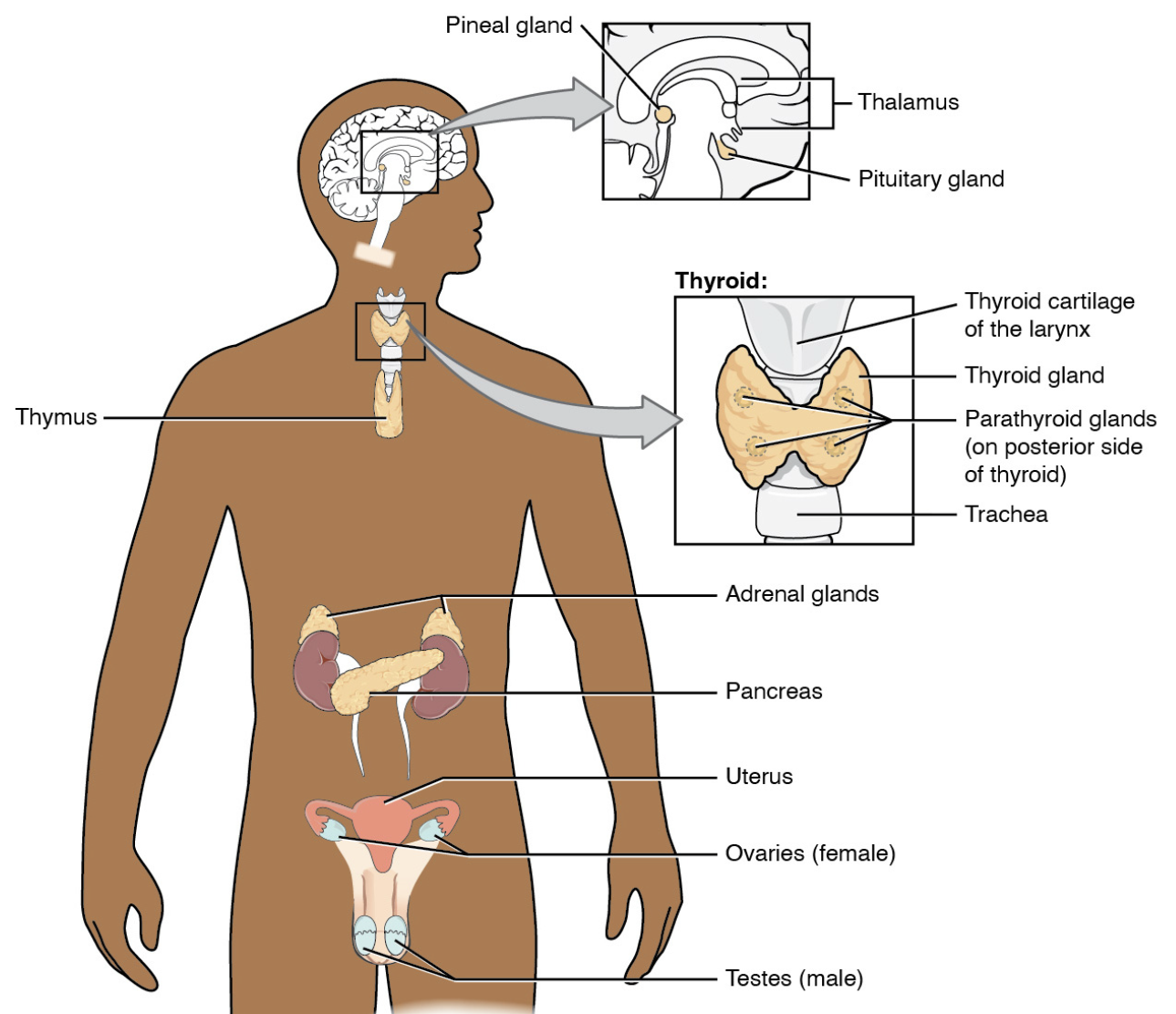
| Letter | Structure | Primary Function |
|---|---|---|
| A | Thymus | Site where T cells (T lymphocytes) mature. T cells are a key component of the immune response. The thymus is both an immune organ and an endocrine gland, releasing hormones that guide the maturation of T cells. |
| B | Pineal gland | Secretes melatonin; helps regulate circadian rhythms and sleep–wake cycles. |
| C | Pituitary gland | Often called the “master gland”; releases hormones that regulate other endocrine glands, growth, reproduction, and water balance. |
| D | Thyroid gland | Produces hormones that regulate metabolic rate, energy use, and heat production throughout the body. |
| E | Parathyroid glands | Regulate blood calcium levels; essential for normal nerve, muscle, and bone function. |
| F | Adrenal glands | Release hormones involved in stress responses, metabolism, blood pressure regulation, and electrolyte balance. |
| G | Pancreas | Regulates blood glucose levels by secreting insulin and glucagon; functions as both an endocrine and digestive organ. |
| Uterus | Not an endocrine gland, but a hormone-responsive organ; supports pregnancy and responds to ovarian hormones. We’ll learn more about the uterus in our unit on the reproductive system. | |
| H | Ovaries (female) | Produce estrogen and progesterone; regulate the menstrual cycle, reproduction, and female secondary sex characteristics. |
| I | Testes (male) | Produce testosterone; support sperm production and male secondary sex characteristics. |
3. Quiz: Key Glands and their Functions
[qwiz use_dataset=”Anatomy Diagrams one letter answers|unit:18.Endocrine System|topic:18.1.Key Glands and their Functions” random=”true” style=”width: 600px !important; min-height: 425px !important; ” qrecord_id=”sciencemusicvideosMeister1961-Major Endocrine Glands and their Functions”]
[h]Key Glands and their Functions
[i]
[/qwiz]
4. Eighteen Hormones to Get to Know
In what’s above, you learned about the major glands of the endocrine system. Now let’s learn about the hormones that these glands secrete. You’ll do this by matching hormones with their glands and functions. Don’t worry if you have to guess a bit. Once you match everything correctly, the completely table so that you can start to be familiar with each hormone.
4a. Hormones: interactive table
[qwiz style=”width: 600px !important; min-height: 400px !important;” qrecord_id=”sciencemusicvideosMeister1961-Eighteen Hormones Interactive Table”]
[h] Eighteen hormones to get to know: Interactive table
[q labels =”top”]
| Hormone | Source Gland | Primary Function / Notes |
|---|---|---|
| ______________________ | Pancreas | Lowers blood glucose by helping body cells absorb glucose. |
| ______________________ | Pineal gland | Regulates sleep–wake cycles and circadian rhythms. |
| ______________________ | Adrenal glands | Longer-term stress hormone; increases available energy and suppresses immune responses. |
| ______________________ | Ovaries | Supports female secondary sex characteristics and bone maintenance. |
| ______________________ | Thymus | Guides the maturation of T cells in the immune system. |
| ______________________ | Adrenal glands | Rapid fight-or-flight response; increases heart rate and blood flow to muscles. |
[l]Adrenaline (epinephrine)
[f*] Correct!
[fx] No, that’s not correct. Please try again.
[l]Cortisol
[f*] Excellent!
[fx] No, that’s not correct. Please try again.
[l]Estrogen
[f*] Good!
[fx] No. Please try again.
[l]Insulin
[f*] Correct!
[fx] No. Please try again.
[l]Melatonin
[f*] Good!
[fx] No, that’s not correct. Please try again.
[l]Thymosin
[f*] Good!
[fx] No, that’s not correct. Please try again.
[q labels=”top”]
| Hormone | Source Gland | Primary Function / Notes |
|---|---|---|
| ______________________ | Pancreas | Raises blood glucose by stimulating the liver to release glucose. |
| ______________________ | Ovaries | Regulates the menstrual cycle and supports pregnancy. |
| ______________________ | Pituitary gland | Stimulates growth of bones and muscles; supports overall body growth. |
| ______________________ | Parathyroid glands | Raises blood calcium levels by releasing calcium from bone. |
| ______________________ | Digestive tract & brain | Helps regulate mood, energy levels, and biological rhythms. |
| ______________________ | Adrenal glands | Contribute to secondary sex characteristics in both males and females. |
[l]Androgens
[fx] No. Please try again.
[f*] Great!
[l]Glucagon
[fx] No, that’s not correct. Please try again.
[f*] Good!
[l]Growth hormone (GH)
[fx] No, that’s not correct. Please try again.
[f*] Good!
[l]Parathyroid hormone (PTH)
[fx] No. Please try again.
[f*] Excellent!
[l]Progesterone
[fx] No. Please try again.
[f*] Good!
[l]Serotonin
[fx] No, that’s not correct. Please try again.
[f*] Excellent!
[q labels=”top”]
| Hormone | Source Gland | Primary Function / Notes |
|---|---|---|
| ______________________ | Thyroid gland | Increases metabolic rate and energy use by cells. |
| ______________________ | Hypothalamus / posterior pituitary | Stimulates uterine contractions and milk release. |
| ______________________ | Hypothalamus | Acts as a neurohormone that inhibits prolactin release; also a neurotransmitter. |
| ______________________ | Thyroid gland | Lowers blood calcium levels by promoting calcium storage in bone. |
| ______________________ | Pituitary gland | Stimulates milk production in mammary glands. |
| ______________________ | Testes | Supports male secondary sex characteristics and sperm production. |
[l]Calcitonin
[fx] No, that’s not correct. Please try again.
[f*] Correct!
[l]Dopamine
[fx] No. Please try again.
[f*] Great!
[l]Oxytocin
[fx] No. Please try again.
[f*] Correct!
[l]Prolactin
[fx] No, that’s not correct. Please try again.
[f*] Excellent!
[l]Testosterone
[fx] No. Please try again.
[f*] Good!
[l]Thyroxine (T4)
[fx] No, that’s not correct. Please try again.
[f*] Good!
[x]
[restart]
[/qwiz]
4b. Hormones fill-in-the-blanks quiz
[qwiz qrecord_id=”sciencemusicvideosMeister1961-Eighteen Hormones Fill-in-the-Blanks”]
[h]Hormones Fill-in-the-blanks
[i]
[q]The hormone [hangman] is synthesized in the [hangman] gland. It helps regulate sleep–wake cycles and circadian rhythms.
[c]bWVsYXRvbmlu[Qq]
[c]cGluZWFs
[q][hangman] hormone is synthesized in the [hangman] gland. It stimulates growth of bones and muscles.
[c]Z3Jvd3Ro[Qq]
[c]cGl0dWl0YXJ5
[q]The hormone [hangman] is synthesized in the [hangman]. It inhibits prolactin release and also acts as a neurotransmitter.
[c]ZG9wYW1pbmU=[Qq]
[c]aHlwb3RoYWxhbXVz
[q]The hormone [hangman] is synthesized in the [hangman]. It stimulates uterine contractions and milk release.
[c]b3h5dG9jaW4=[Qq]
[c]aHlwb3RoYWxhbXVz
[q]The hormone [hangman] is synthesized in the [hangman] gland. It helps regulate metabolic rate.
[c]dGh5cm94aW5l[Qq]
[c]dGh5cm9pZA==
[q]The hormone [hangman] is synthesized in the [hangman] gland. It lowers blood calcium levels.
[c]Y2FsY2l0b25pbg==[Qq]
[c]dGh5cm9pZA==
[q][hangman] hormone is synthesized in the [hangman] gland. It raises blood calcium levels.
[c]cGFyYXRoeXJvaWQ=[Qq]
[c]cGFyYXRoeXJvaWQ=
[q]The hormone [hangman] is synthesized in the [hangman]. It guides the maturation of T cells.
[c]dGh5bW9zaW4=[Qq]
[c]dGh5bXVz
[q]The hormone [hangman] is synthesized in the [hangman] gland. It produces a rapid fight-or-flight response.
[c]YWRyZW5hbGluZQ==[Qq]
[c]YWRyZW5hbA==
[q]The hormone [hangman] is synthesized in the [hangman] gland. It helps the body respond to long-term stress.
[c]Y29ydGlzb2w=[Qq]
[c]YWRyZW5hbA==
[q][hangman] are hormones that are synthesized in the [hangman] glands. They contribute to secondary sex characteristics in both sexes.
[c]YW5kcm9nZW5z[Qq]
[c]YWRyZW5hbA==
[q]The hormone [hangman] is synthesized in the [hangman]. It lowers blood glucose levels.
[c]aW5zdWxpbg==[Qq]
[c]cGFuY3JlYXM=
[q]The hormone [hangman] is synthesized in the [hangman]. It raises blood glucose levels.
[c]Z2x1Y2Fnb24=[Qq]
[c]cGFuY3JlYXM=
[q]The hormone [hangman] is synthesized primarily in the [hangman] tract. It helps regulate mood and biological rhythms.
[c]c2Vyb3Rvbmlu[Qq]
[c]ZGlnZXN0aXZl
[q]The hormone [hangman] is synthesized in the [hangman]. It supports female secondary sex characteristics.
[c]ZXN0cm9nZW4=[Qq]
[c]b3Zhcmllcw==
[q]The hormone [hangman] is synthesized in the [hangman]. It supports the menstrual cycle and pregnancy.
[c]cHJvZ2VzdGVyb25l[Qq]
[c]b3Zhcmllcw==
[q]The hormone [hangman] is synthesized in the [hangman]. It supports male secondary sex characteristics.
[c]dGVzdG9zdGVyb25l[Qq]
[c]dGVzdGVz
[q]The hormone [hangman] is synthesized in the [hangman] gland. It stimulates milk production.
[c]cHJvbGFjdGlu[Qq]
[c]cGl0dWl0YXJ5
[/qwiz]